Ever wonder why national news headlines report fluctuating fuel prices, yet the prices at our local pumps and bulk tanks don’t always match what you hear on TV? The answer comes down to local infrastructure, transport logistics, and a key concept known as basis pricing.
National Headlines vs. Local Reality
When following energy markets, most national headlines focus strictly on benchmark crude oil prices or nationwide inventory data published by the U.S. Department of Energy (DOE).
However, national numbers don’t tell the full story. Reports like the weekly DOE report aggregate inventory for the United States as a whole rather than showing individual regional breakdowns.
While national figures set global market direction, basis pricing is what determines the local reality. Basis pricing is simply the regional cost of moving fuel from where it is refined to where it is needed. Where you live—and how easily fuel can reach your region—has just as much impact on the price you pay as global crude trends.
What is a PADD? A Brief History
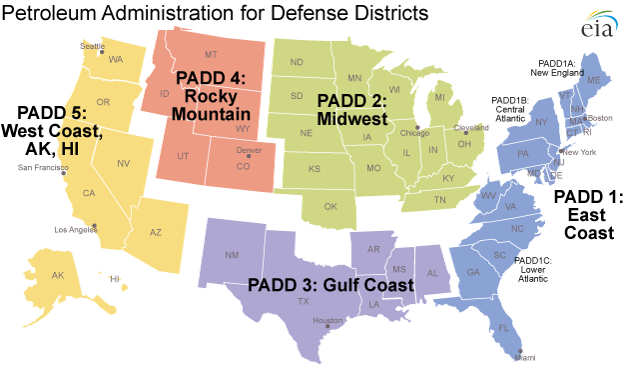
To track crude oil and refined petroleum movements across the nation, government agencies and market analysts divide the country into five geographic regions known as PADDs (Petroleum Administration for Defense Districts):
- PADD 1: East Coast (New England, Central Atlantic, Lower Atlantic)
- PADD 2: Midwest (Including Minnesota and surrounding states)
- PADD 3: Gulf Coast
- PADD 4: Rocky Mountain Region
- PADD 5: West Coast (Including Alaska and Hawaii)
Where Did PADDs Come From?
The system dates back to World War II. Established by Executive Order in 1942, the Petroleum Administration for War created these five districts to ration gasoline for the war effort. Although abolished in 1946, Congress reactivated the district model under the Defense Production Act of 1950, creating the Petroleum Administration for Defense. Today, the PADD framework remains the industry standard for tracking energy movements and regional inventories across the United States.
The Midwest Advantage: Strong Supply Logistics
Each PADD is unique in how it receives and distributes fuel. Many regions outside the Midwest face supply bottlenecks because they rely heavily on limited delivery options.
Here in the Midwest (PADD 2), we hold one of the strongest supply advantages in the country. Our region features robust, multi-modal transport infrastructure, receiving refined fuel via:
- Pipelines
- Rail lines
- Transport trucks
Because of these diverse transportation networks, PADD 2 is typically far better supplied than coastal or mountain regions.
What Current Basis Values Mean for You
When our regional supply is strong, Midwest basis values lower. In simple terms: the Midwest effectively discounts fuel relative to other parts of the country. Lower basis pricing allows excess fuel from PADD 2 to help supply regions like the East/West coasts or Rocky Mountains that face stricter transportation constraints.
“Even though national headlines move the overall market, local supply and regional logistics determine what we actually pay here at home.”
The Takeaway for Our Customers
When energy markets feel volatile, it helps to remember that global crude prices are only part of the equation. Our region’s access to pipelines, rail, and trucking infrastructure keeps Midwest basis values strong and helps protect local producers, businesses, and homeowners from the severe supply squeezes seen in other parts of the country.
Have questions about fuel contracting, bulk delivery, or market trends? Reach out to the Centra Sota Energy Team today.